
NuPrime ANC GaN Power Supply and Its Impact on Audio Performance
When space is limited, NuPrime’s ANC GaN power supply delivers much higher power density—more power from a smaller supply—with performance equal to the best low-noise linear power supplies.
This is a performance and packaging choice. NuPrime’s ANC GaN PSU actually costs more than a comparable linear PSU.
How does it work?
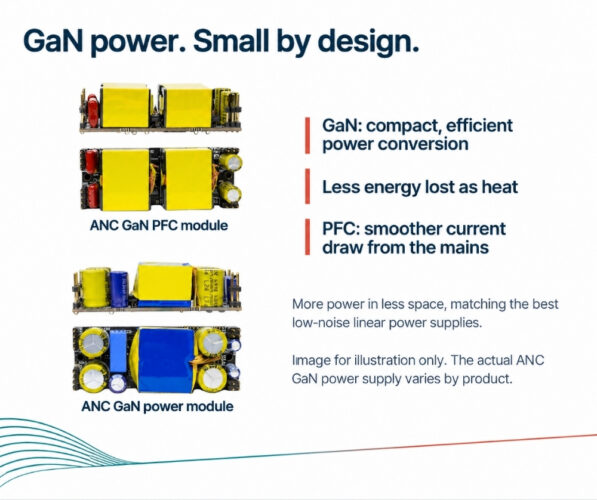
GaN technology enables compact, efficient power conversion.
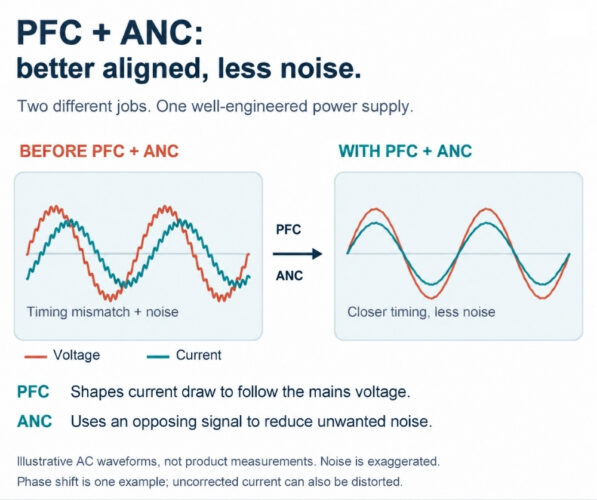
Power Factor Correction (PFC) helps the supply draw current more smoothly from the mains.
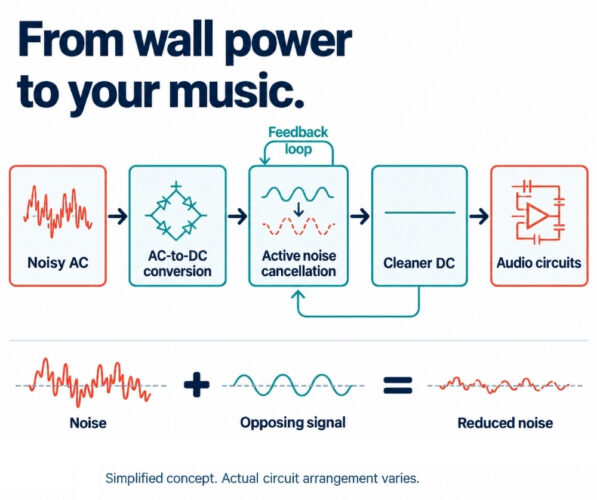
Active Noise Cancellation (ANC) senses unwanted power supply noise and applies an opposing correction signal to reduce it—similar in principle to noise-cancelling headphones.
NuPrime uses ANC GaN power supplies in the IA-9XG, IDA-9 and Evolution STA-SE.
Technical Details
What Is Power Factor?
Power factor (PF) describes how effectively a device uses the current it draws from the AC mains. It is the ratio of real power, measured in watts, to apparent power, measured in volt-amperes (VA). A PF close to 1 means less current is needed to deliver the same amount of useful power.
Two things can reduce power factor: a phase shift between voltage and current, and distortion of the current waveform.
- Resistive loads, such as heating elements, draw current in phase with voltage and have a PF close to 1.
- Capacitive and inductive loads store energy in electric or magnetic fields. Current leads voltage in a capacitive load and lags voltage in an inductive load.
- Non-linear loads, including many electronic power supplies, draw current in pulses rather than a smooth sine wave. This distortion can lower PF even when there is little phase shift.
Some household electronics without correction can have a PF as low as 0.3–0.5. A low PF means more current flows through wiring and transformers for the same useful power, increasing losses and the burden on the electrical supply.
Power Factor Correction (PFC) shapes the input current to follow the mains voltage more closely. Active PFC can achieve a PF of 0.95–0.99, depending on the design and operating conditions. PFC improves how power is drawn from the grid; it does not, by itself, reduce the power needed by the audio circuits.

How Conventional Linear Power Supplies Work
Many high-end audio amplifiers use linear power supplies with large transformers and banks of filter capacitors. A well-designed linear supply provides clean, low-noise DC, but its size, weight and heat output can be substantial.
In a typical rectifier-and-capacitor design, the capacitors recharge in short bursts near the peaks of the AC waveform. These current pulses introduce harmonics and can produce a PF of around 0.5–0.7. The extra current can increase losses and place more demand on wiring and transformers, especially in high-power installations.
What GaN and PFC Bring to a Power Supply
Gallium nitride (GaN) switching devices enable efficient power conversion at high frequencies. High-frequency GaN designs can operate in the 500 kHz–2 MHz range, although the actual frequency depends on the circuit. This allows smaller magnetic components and helps increase power density: more power from a smaller supply.
When combined with PFC, effective filtering and careful regulation, GaN technology offers several advantages:
- Low noise: Switching well above the audio band makes switching noise easier to filter. Ultra-low-noise designs can match the DC noise performance of high-quality linear supplies. Fast switching still requires careful layout and filtering to control interference.
- Better mains current draw: Active PFC produces a smoother input-current waveform and a PF of 0.95–0.99, reducing current harmonics and the burden on the electrical supply.
- Stable voltage: The PFC stage regulates an intermediate DC voltage. The downstream conversion and regulation stages maintain the output supplied to the audio circuits as mains voltage and load change.
- Smaller size and less heat: Efficient switching allows a compact, lightweight supply with less heat generation than a comparable, less efficient linear design.
How Active Noise Cancellation Reduces Noise
Incoming AC power can carry unwanted high-frequency noise. The switching and conversion stages can also generate noise. Active Noise Cancellation (ANC) senses unwanted noise and applies an opposing correction signal to reduce it, similar in principle to noise-cancelling headphones.
In a simplified power-supply sequence, incoming AC noise is reduced, the AC is converted and regulated into DC, and further noise reduction helps provide clean DC to the electronic circuits. The exact sensing points and arrangement of the ANC stages depend on the design.
PFC and ANC serve different purposes: PFC improves the input-current waveform; ANC reduces unwanted noise. Both work alongside the supply’s conversion, regulation and filtering stages.
What This Means for Audio Systems
Linear supplies have long been valued for low noise, while switching supplies offer efficiency and compact size. A carefully designed ANC GaN supply can combine these strengths: clean DC, stable output voltage, high efficiency and a smaller, lighter package.
High power factor primarily benefits the electrical supply infrastructure. It may reduce charges in commercial installations where tariffs account for power factor or apparent-power demand. Household bills usually depend on real energy use (kWh), so PFC alone generally brings little direct saving. Conversion efficiency is a separate measure: a more efficient supply wastes less energy as heat.
GaN technology alone does not guarantee low noise or better sound. Performance depends on the complete design, including component quality, circuit layout, regulation, filtering, and control of electromagnetic and radio-frequency interference (EMI/RFI).
Conclusion
NuPrime’s ANC GaN power supply combines DC noise performance comparable to high-quality linear supplies with a near-unity power factor of 0.95–0.99 and efficiency above 90%. Its compact, lightweight design reduces heat and space requirements, while active regulation helps maintain stable operation through mains-voltage and load changes.
The benefit is practical as well as electrical: clean, stable power for audio circuits in a smaller, more efficient package.